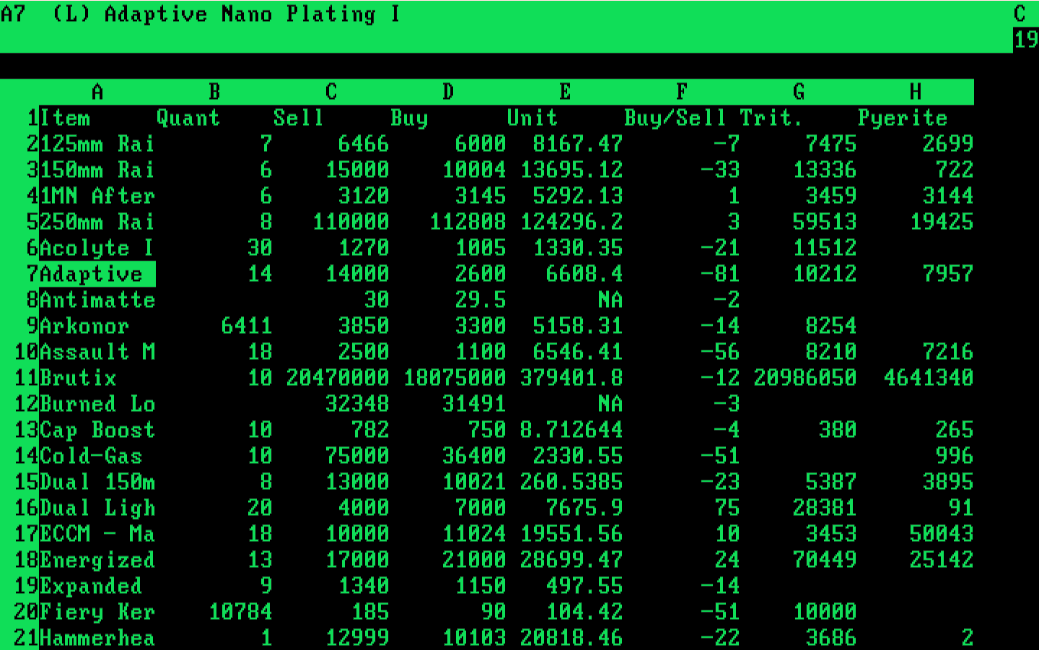
This one comes from CrazyKinux’s excellent EVE Online blog. When I realized I had a longer history with what would become EVE Online than, perhaps, most of the people who currently play, I felt I had to participate.
Here’s the prompt:
EVE Online is now more than two decades old—older than some of its players. In a genre where most MMORPGs fade or shut down, EVE has kept evolving. What do you think is the secret behind its longevity? Why is EVE still here—and still feeling alive—when so many of its contemporaries have declined or disappeared?
Before we discover the reasons behind EVE Online’s longevity, we need to look at its distant past to understand its origins.
Set the time machine to 1981, location: Cambridge, Massachusetts.
Dan Bricklin was attending a presentation at Harvard Business School, watching the presenter struggle with correcting numbers and calculations, by hand, on a transparency. Bricklin thought that was just the sort of thing that a computer might be able to do, faster and without error. In 1979, he and his co-developers published VisiCalc for the Apple ][, instantly turning the second computer from Apple into a must-have device for every office. Any new computer had to run VisiCalc to be taken seriously, and yada yada yada, the modern world exists, thanks to Mr. Bricklin.
Spreadsheets could be done by a computer. Also able to be done on a computer: games. Atari’s Star Raiders defined what a space combat and exploration game could do and became a huge influence on the early space trading simulator Elite, which itself was one of the main inspirations for … EVE Online.
Spreadsheets and space combat? One program took up what VisiCalc and Star Raiders put down. And that program was a little spreadsheet called CalcStar. This MicroPro International invention was the first to ask — and answer — the question: Why can’t you destroy spaceships while you’re working?
“Calc” and “Star”. Guys, it’s right in the name.
Okay, that didn’t happen. It should have happened, but it did not. Unfortunately, MicroPro dropped the ball here, and what they delivered was an overstuffed WordStar add-on that they hoped would join MailMerge and DataStar as office suites that would compete with other all-in-one office solutions. No spaceships to destroy.
But what if I told you that there was a multiplayer, computer adjudicated, space conquest and trading game that predated EVE Online, Elite, Star Raiders and even the Apple ][ itself?
In 1975, Rick Loomis and his company Flying Buffalo brought multiplayer interstellar exploration, trading and combat to an eager and waiting world with Starweb.

It’s hard to imagine just what an innovative force Flying Buffalo was, in its day. I’ve written about Tunnels & Trolls and Ace of Aces and Lost Worlds, but those games only scratched the surface of the games in which Flying Buffalo, and by extension, Rick Loomis, were involved.
Although Flying Buffalo published all these games from other designers, Starweb was Rick Loomis’ baby. And he ran it on the world’s first gaming computer — a Raytheon 704 minicomputer. Back in 1975, you couldn’t just buy one of these, and gaming wasn’t considered a legitimate use for a computer that would require an IT department — or a computer that would run only games.
Although Starweb was run on a computer, players played the game by mail. Later e-mail, but when it started, the kind of mail that required stamps.
In a game of Starweb, 15 players take on various roles in the game. Like a game of Mafia, the roles are known only to the players themselves, and they may hide or reveal their roles as they decide. Each role has their own win conditions:
- The EMPIRE BUILDER gets points for owning worlds, industry, mines, and population.
- The APOSTLE gets points for converting population to his religion. Just by having a fleet at one of your worlds, he converts some of your population, and if he converts the entire population of the world, he captures the world without firing a shot! But if you shoot at the converted ones, he gets even more points for the `martyrs’!
- The PIRATE gets points for owning fleets and for plundering worlds. He is the only player who can capture your fleets from you instead of destroying them.
- The MERCHANT gets points for carrying metal for people to their homeworlds.
- The ARTIFACT COLLECTOR gets points for accumulating the various artifacts that are scattered throughout the game.
- The BERSERKER gets points for killing things, and a bonus for destroying an entire planet! The idea for the robot Berserkers comes from stories written and copyrighted by Fred Saberhagen, and is used with his permission. “Berserker” is a registered trademark of Fred Saberhagen.
The winner is the first to 10,000 points.
Everyone starts out equally, with single homeworld located somewhere in a galaxy of 255 star systems, possessing only the resources available on that world and five “fleet keys”. Every ship must belong to a fleet, and players can only have as many fleets as they have keys. Additional keys, and therefore additional potential fleets, can be found in some systems. Amassing keys and fleets allows the player to do additional things during their moves. Someone who possesses a lot of keys is in a strong position.
Unlike EVE Online, a game of Starweb eventually comes to an end, and it has winners and losers. But in many ways, EVE copies its distant ancestor. Skill points continue to accrue while you’re logged out; in Starweb, the game runs in the days between when you send in your move and when you get your reply. In both games, players plot and scheme outside of the game, through forums. And in both games, people become very attached to their characters and fleets.
There’s a line from Starweb to EVE Online that runs straight through STRTRK, Star Raiders, Elite, and Traveller. To find the clues to EVE‘s longevity, you just have to look for the players who’ve kept the space empire dream alive for fifty years.
Want more?
- The Ancient Gaming Noob — Reviewing 2023 Destruction in EVE Online
- The Nosy Gamer — Twenty Years Of EVE Online As Viewed By The Board Of Directors
- EVEOGANDA — 17 Years of Eve Online
- The Digital Antiquarian — Friends of the Wasteland: The Legacy of Flying Buffalo
- Cult of the New — Play By Email Week: Two from Flying Buffalo



Leave a Reply to New Eden Banter #1 – Top Ten Reasons EVE Online is Still a Thing in 2026 | The Ancient Gaming NoobCancel reply