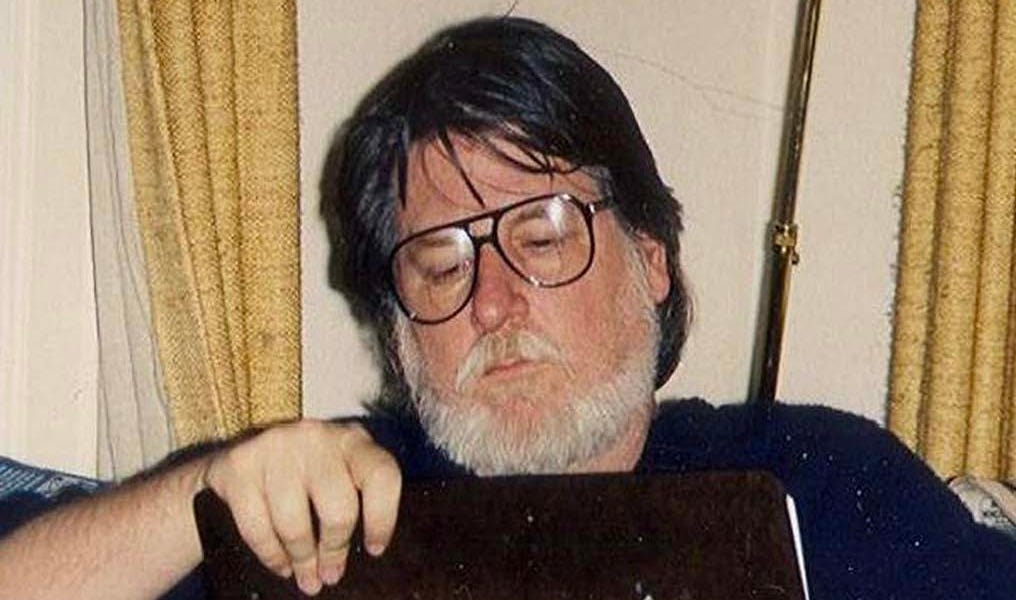
Most authors, I can’t remember the first work of theirs I read. With John Varley, it’s easy — the book was Titan. The first human mission to Saturn discovers an immense alien habitat 600 km wide orbiting the planet. Tentacles reach out and grab the ship and pull it in. They wake up in a fantastical alien environment inside the ship, and some of them have been changed.
The adventure continued into the books Wizard and Demon, comprising the Gaean trilogy, and I was hooked. Those weren’t even his best books! Through a bunch of short stories collected in two or three volumes, to the world building of his Eight Worlds stories, Varley dropped idea after idea. Two of his works were made into movies (that I know of) — Millennium and Overdrawn at the Memory Bank. OatMB would be better watched with the Mystery Science Theater 3000 crew, but Millennium was somewhat watchable. The book was better.
Late in his career, Varley published three (later: four) books that were a homage to Heinlein’s juveniles — Red Thunder, Red Lightning, and Rolling Thunder, collected into the an omnibus collection, Thunder & Lightning. The fourth book, Dark Lightning, wasn’t part of it, and the omnibus is all I could easily find.
I’d read Red Thunder some years ago, but while I appreciated the effort, the gee whiz Tom Swifty vibe just didn’t gel with me, and I never did read the other books.
Briefly; in Red Thunder, four kids on a near future Earth where climate change is devastating the Florida coast chance upon a washed-out astronaut after nearly running him over while four wheeling on Daytona Beach. They bring him back to his home and happen upon his idiot savant cousin Jubal, who has invented a machine that can form sixth dimensional bubbles of compressed space-time that can be used as a total mass-energy conversion engine. Along with the astronaut, they concoct a plan to build a Mars rocket to get to Mars before a Chinese mission can land, and perhaps rescue an American mission that will arrive too late and perhaps explode.
Varley tries to keep up with Heinlein’s trademark self aware chattiness from the main character, but he can’t keep it up for the length of the novel and by the end does little more than drop the titles of Heinlein’s juveniles while letting the plot play out to its end. I considered it a weak novel when I read it, and this reread didn’t change my opinion much.
Red Lightning is set about twenty years later. Free space travel and energy has unleashed a wave of immigration to Mars, and starships have visited everywhere that’s interesting and many places not that interesting in the solar system. Some starships have even left the system entirely, being able to boost at 1g pretty much continuously means that, at lightspeed, the entire galaxy is within reach. More than that, Jubal has invented a bobble device that can stop time itself within a sphere. When a returning starship moving at near lightspeed grazes the Earth in the south Atlantic, devastation destroys much of the Caribbean and southeast US, including Florida. First book protagonist Manny Garcia and his son Ramon “Ray” Garcia return to Earth from Mars to rescue their remaining family. The incident proves the tipping point for war among the remaining inhabitants of America, prompting a worldwide refugee crisis. Earth decides it needs to have full control over the squeezer and bobbler tech (which can only be produced by Jubal), provoking a crisis between Earth and Mars.
Rolling Thunder picks up another twenty years later, with third generation Mars lieutenant (junior grade) Podkayne posted to Earth to dissuade Earthers from emigrating to Mars. Varley tries his best to match Heinlein’s weird fascination with how he thinks teenage girls think as demonstrated in the original Podkayne of Mars, but he swaps that out for nods to Kim Stanley Robinson’s A Memory of Whiteness, and (naturally) Robinson’s Red/Green/Blue Mars trilogy.
Mars has colonized the Solar System and keeps a weather eye on Earth, still struggling with the lingering effects of the starship strike in the second book. Mars still controls the squeezer and bobble tech, and relations between the two planets are strained but cordial. Podkayne returns to Mars to attend her great grandmother’s bobbling ceremony, where elders and the terminally ill enter a stasis bubble until such time as what ails them can be cured, although most acknowledge that it’s unlikely they will ever be unbobbled. Podkayne is posted as a chanteuse for a traveling jazz band based in Europa and traveling through the Mars bases throughout the Jovian system. There she stumbles upon alien life that seems entirely unaware of the existence of humanity, or the devastation that follows as the mountain-sized crystalline creatures leave Europa to settle upon Earth, causing an extinction event.
This mirrors Varley’s Eight Worlds books, where a mysterious alien race that inhabits gas giants settles on Earth, removing all technology and banishing humanity to the outer worlds (and eventually, kicks them out of the Solar System entirely).
Now Mars has to deal with its own refugee problem — the entire remaining population of Earth.
The second and third volumes of the trilogy are far better than the first. The themes are darker and more adult; Varley clearly feels free to expand his homage from Heinlein’s juveniles to include KSR and Samuel Delaney, among others, while also tying in to the themes of environmental collapse, human expansion, and the unknowable strangeness of true aliens explored in other works.
I wouldn’t start a Varley read with these books; I’d start with one of the short story collections, The Barbie Murders or Blue Champagne. But for completionists who remember the Heinlein juveniles fondly, give them a shot? They’ve aged better than Heinlein. (In the third book, Varley’s Podkayne even mentions how terrible the Heinlein book was).


Leave a Reply